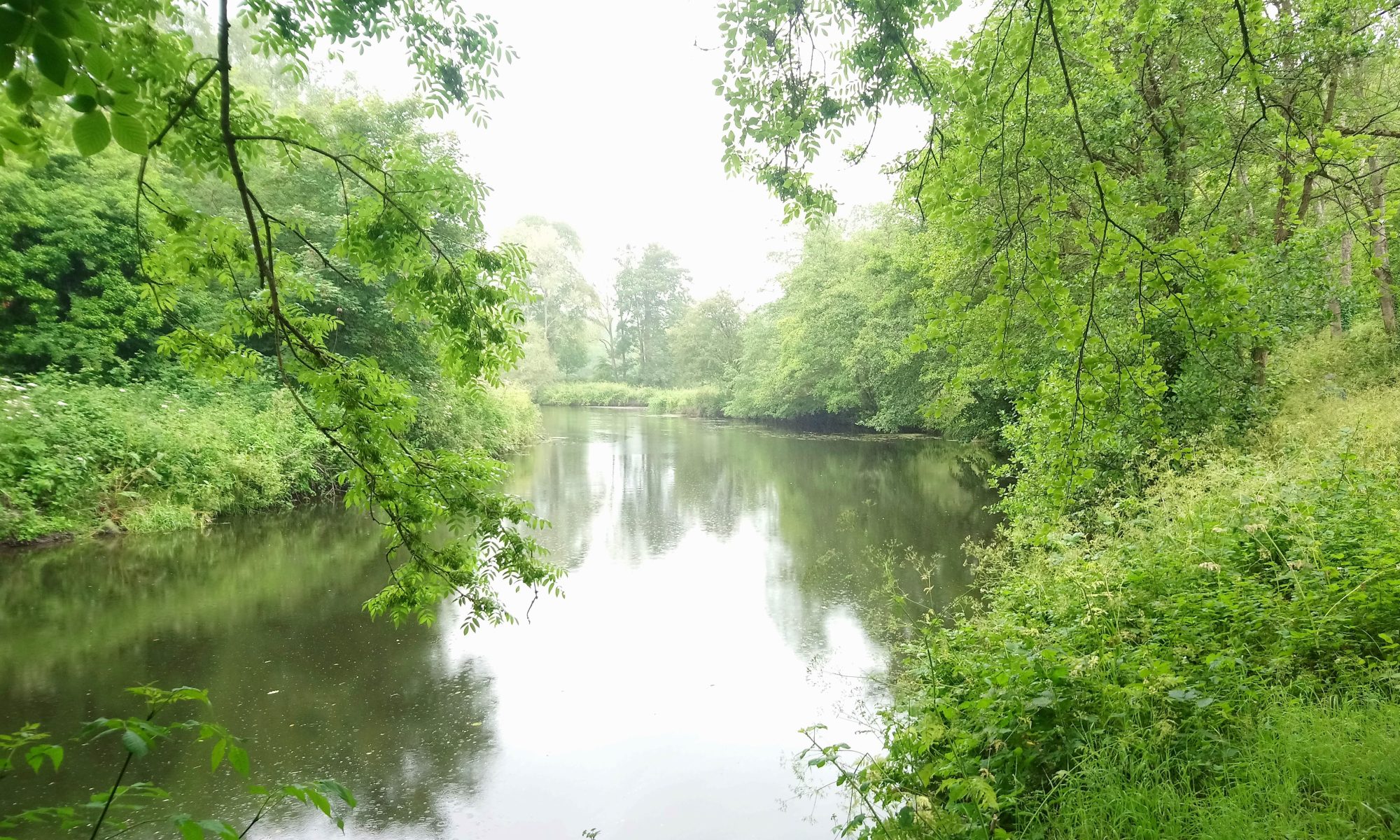
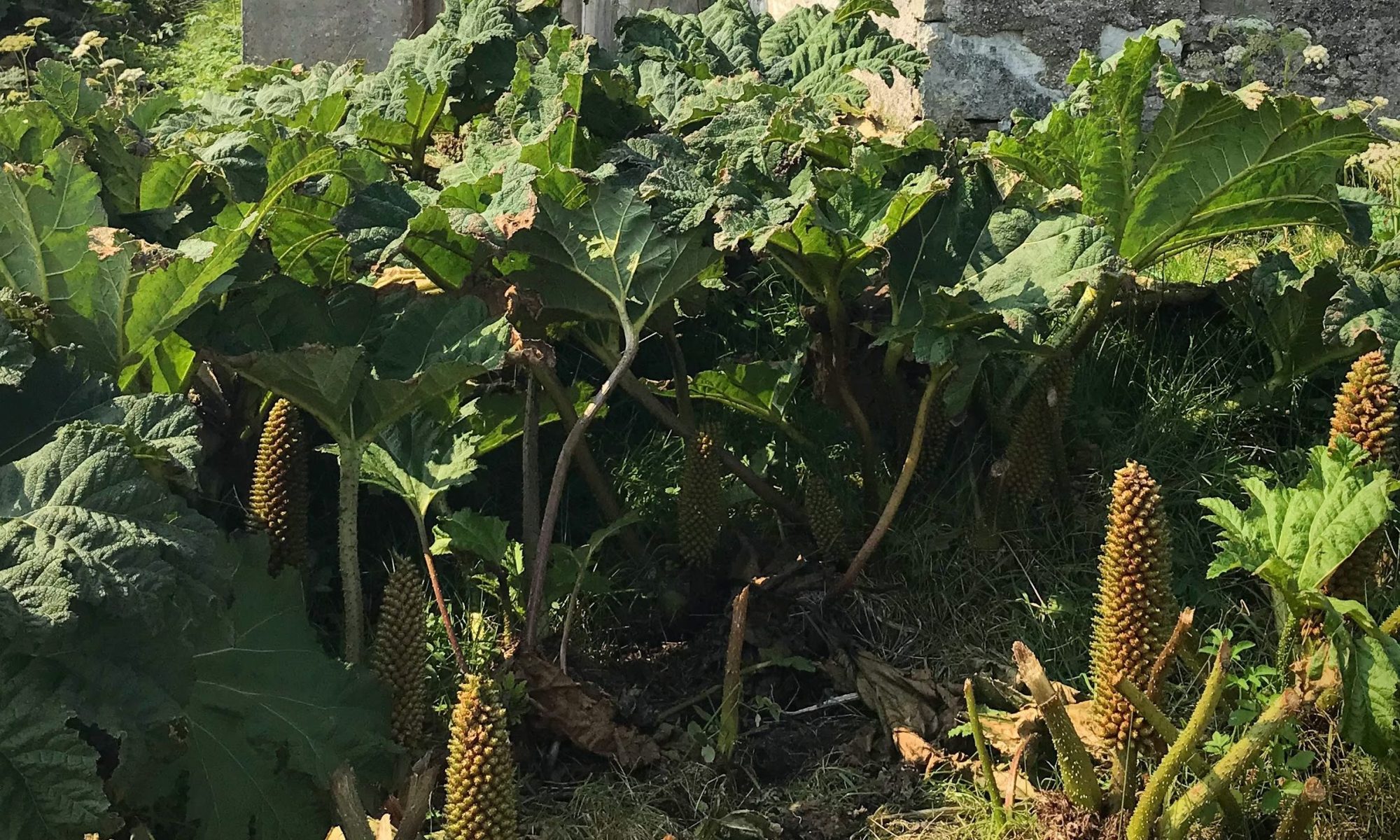
Living in Achill, there is no way to escape being aware of invasive species. Giant rhubarb, or gunnera tinctoria, spreads through all the ditches, streams and rivers that make of the already wet island. Seasonal flooding that would have once fertilised low-lying fields now covers them in a stubborn monoculture that has been spreading across Achill since the 1930s. Invasive species are one of the key drivers of biodiversity loss all over the world. Increasingly dense stands of rhododendron ponticum replace scrubland and hedgerows, choking out competition. There are communities all over Ireland already dealing with the consequences and despite lots of work to make the conversation more mainstream, what’s been produced outside of surveys is largely lip service.
My recent experiences in dealing with invasive species led to a recent opinion column in The Journal, which has been pretty well received. I paired it down to specifically the issues I’d been facing over the summer trying to understand why there is such inaction and the problems facing community groups attempting to step up where the government has failed.
State owned land across the country is overrun with invasive species, of which plants make up the majority. The Department of Housing, Local Government and Heritage (which has responsibility for biodiversity and national parks, etc.) announced with great media excited the created of an Invasive Alien Species Bureau to address the problem. This raised some red flags with me, a semi-professional cynic at the best of times, since “bureau” is not a term used commonly in the Irish civil service and there was no funding or specific actions outlined in the press materials. There is already a biosecurity unit within the Department of Agriculture, an invasive species officer in the National Biodiversity Data Centre and the National Parks and Wildlife Service, so what role would this bureau actually hold? Where would it fit within the civil service given that clear management structure is already such a problem for the NPWS? (see 2021 review in sources below)
I reached out to Jennifer Whitmore about submitting a parliamentary question and her office was nice enough to agree. They asked: “To ask the Minister for Housing; Local Government and Heritage the structure of the new Invasive Species Bureau; whether it will be an agency or a unit within his Department; whether it will have its own dedicated staff; if not, if it will be comprised of existing members of the civil service; and if he will make a statement on the matter?” (PQ 383 14 July 2026)
The answer received was two paragraphs of waffle on what invasive species are before getting to anything that corresponded to the question. The minister’s office did confirmed that “the new Invasive Alien Species Bureau will not be a new agency or unit within my Department. Instead, the Bureau will be a new partnership approach between the National Parks and Wildlife Service (NPWS) and the National Biodiversity Data Centre (NBDC). One of the first actions for the Bureau will be to develop a strategic approach towards invasive alien species. This strategy will be developed throughout the rest of 2026 and into 2027. It is envisaged that the final strategy will set out key goals and objectives that help sustain a “whole of government, whole of society” approach to invasive alien species in Ireland. To accomplish this, the Bureau will build on existing initiatives of coordination with government departments and agencies. An additional priority for the Bureau will be to support NPWS-led efforts in delivering effective rapid response for priority invasive alien species such as the Asian Hornet. Staffing arrangements for the new Bureau are currently being finalised.”
It does not take much reading between the lines here to see that there will be no new dedicated staff, very little change from current activities, and that this is simply a branding exercise for existing partnerships between the NPWS and the NBDC rather than a new “bureau” in any traditional sense of the word.
Collette O’Flynn is the invasive species officer with the National Biodiversity Data Centre and she raised with Pádraic Fogarty in February of this year that the NBDC’s role is to receive and organised sightings, rather than intervene. Good data is the basis of all good plans of action. However, O’Flynn also said that it was not clear who was responsible for the removal of listed invasive species. “There is a piece of work that is badly needed on clarifying roles and responsibilities and looking at governance across Ireland, and that’s both from central government and state agencies,” she is quoted by Fogarty as saying. “But we don’t have a plan. We don’t have a strategy.”
Where government policy fails, local community group or voluntary organisations often step up to fill the gap. In this case, this is being actively discouraged by councils and national policy. While there are real concerns of biosecurity and it’s important not to spread an invasive species even further through poorly planned attempts to remove it, some areas of the country are so badly affected that to do nothing holds just as high a risk.
There are two routes for the removal of invasive plants species. Chemical or manual and both come with their advantages and disadvantages. Treatment with chemical pesticides like glyphosate can be very effective when done responsibly. There is a license to use it professional that requires a short training course. This doesn’t guarantee responsible use, but it does set a benchmark for what we mean by qualified when assigning the job of clearance.
Less favourably, glyphosate is linked to dropping insect numbers globally and so the fact that it is the unquestioned solution to all invasive concerns should be challenged. This isn’t to say it doesn’t have its place. The best practise for rhododendron clearance involves a person cutting a notch into the trunk of the shrub and applying herbicide directly there. Then the plant has to be left uncut until the herbicide has spread throughout the plant’s root system and it has stood dead with no regrowth. When done carefully in dry weather, the effect on other organisms can be minimal. Gunnera too can be treated chemically and most state or official guidelines say to spray the leaves. This is not nearly as reliable as the above method for rhodies and ignores how often gunnera grows in watercourses or flooded areas, meaning the use of glyphosate is not recommended.
That leaves manual clearance, meaning physically removing by digging up the plants and its roots to remove it from the infected site. This is slow, labour intensive, and potentially expensive. However, it would be possible to reduce costs if volunteers or community groups can organise large groups to collaborate, after some basic training in biosecurity, such as cleaning boots and tools. Gunnera can, in theory, regrow from any part of the plant. A small fragment of rhizome can become an entire new plant if left on the soil. When removing gunnera, its green waste should be isolated.
This is stalled however by the fact that regulations about “Third Schedule Species”, meaning invasive such as gunnera, cannot be removed from a site or transported without license. The procedural and licensing nightmare that emerged from that rabbit hole was the main subject of my Journal article, so I won’t repeat it here. If a local community group did organise the labour, there is no scheme available currently that would provide funding assistance. The Local Environmental Action Fund (LEAF) could theoretically provide up to €9,000 towards this, but I was informed that they would not fund the removal of invasive species unless it was invoiced by a “qualified” environmental consultancy company. When I pressed for what “qualified” meant, there was not a firm answer or specified definition.
After a week of frustrating emails and phone calls between me, the county council and other groups, it was made clear that there were no options other than paying extortionate costs to private environment management companies, who rarely take on small jobs or ones in delicate environments were large machinery is inappropriate. There is no public funding that supports community groups doing anything more than paying consultants or holding public meetings. The idea that local labour could be paid for out of an environmental grant was met with a stunned “why?” on one memorable call.
The tone of most of the conversations I have had or the documents I have read doesn’t even seem to take the concept of eradication seriously at all.
Here is where the problem strikes. In an attempt to avoid the high costs of paying for manual labour, something that is often undervalued in both state policy and in scientific communication, there were multiple failed attempts at less effective clearance. The situation worsened, the potential cost is even higher.
Sources
Fogarty, Padraic (12 February 2026) ‘We don’t have a plan: Invasive species take hold as action lags legislation’ The Irish Times (Accessed 5 July 2026)
O’Flynn; Kelly; & Lysaght (2014). Ireland’s invasive and non-native species – trends in introductions. National Biodiversity Data Centre Series No. 2. Ireland (Accessed 5 July 2026:
Stout, Jane; & Ó Cinnéide, Micheál (2021) Review of the NPWS

