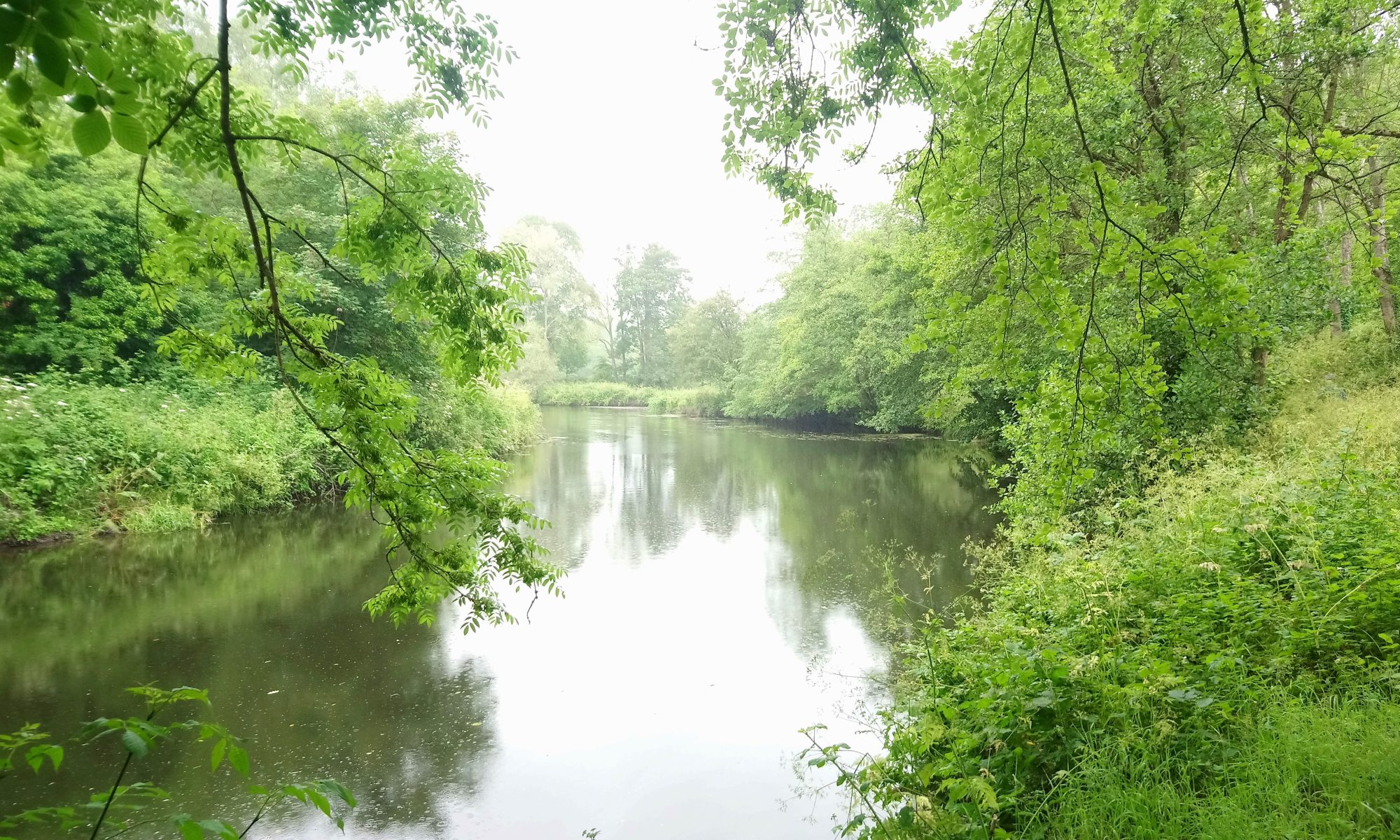
Each pore fights the river cold.
Bones stiffen, locking my limbs.
Feet on stones feel for ridges and ribs.
A slide-shift to the one bit of sand
And hurrah for me, I can stand!
Hello, says the slow but steady flow.
Hello I say, wary now,
Knowing how it fills the fields,
Leaves a layered skim of grey silt.
– An extract of ‘River-Talk’ by Siobhán Campbell, from the Empty House anthology.
On the 18th of October, the Irish Metrological Office, Met Eireann, issued an Orange weather warning for some parts of the country ahead of Storm Babet but very few people predicted the scale of flooding that would hit towns in Cork. It has raised a number of questions in the media in the past week, on the effectiveness of the weather warnings, on flood preparedness by county and city councils and the need for increased adaption and mitigation as the effects of climate change make themselves known.
The town of Midleton in Cork was one of the worse effected, videos circulated on social media of flood waters so deep that small cars were floating. Hundreds of homes and business were damaged. Other towns throughout the county dealt with differing levels of flooding and road closures. Cork City centre and south were included as well, though flooding along the Lee has become common place enough that this received less online attention.
The climate conversation on flooding often gets bogged down, if you’ll pardon the pun, in whether scientists can conclusively prove that any individual extreme weather event was caused by climate change. That argument misses the point since the issue is of trends over time rather specific storms. That said, sometimes the focus on the big picture climate conversation can distance people from what can be done of the ground.
Outside of pointing to the most recent set of floods as another illustration of just how seriously people need to start taking the need to reduce emissions, it doesn’t necessarily connect with anyone who doesn’t have that kind of influence day to day. Part of climate adaptation isn’t just trying to stop things getting worse, it’s also adjusting to things that have already changed.
Ireland is no stranger to flooding. This is a famously rainy country. So why have we found ourselves so consistently under prepared for these kind of floods? We have the climatic conditions meaning we’re getting more extreme weather events than before but also the landscape that weather is colliding with is measurably different than previous decades.
The Central Statistic Office released figures on changing land use in Ireland that shows a 16% increase settlements and other artificial areas between 2000 and 2018 and 4% decrease in inland wetlands in the same period. More hard landscaping, meaning use of impermeable materials like tarmac and concrete, gives water less places to go. Reductions in wetland, which obviously hold the most water, exacerbates this problem. There’s a certain level of this that’s common sense, water has to go somewhere. If it’s met with hard infrastructure that pushes it onwards than it goes there with a greater volume and greater speed. Speed is one of the things that determine how dangerous a flood is and how effectively it can be responded to. This is where the debate around dredging and riparian vegetation comes in.
There are three terms you’ll hear used in the conversation about river management in Ireland. Dredging, vegetation removal and either bank straightening or canalisation. Dredging is the removal of sediments and debris from the bottom of lakes, rivers, harbours, and other bodies of water. If not interfered with then silt naturally builds up over time either shifting the direction of a mature river, filling lakes and reshaping bays. However, where there are humans activities like a commercial port, dredging is necessary in order to keep the water deep enough where the harbour has been built. It also increases the speed of the water moving downstream in a river system. Riparian vegetation just means all the trees and plant life on the banks of a river. Straightening the course of a river is canalisation because it is making a river more like a canal, this alters the banks and also increases the speed and potentially depth of water in that river.
Dredging, canalisation, and excess vegetation removal in regards Irish rivers has been criticised by ecologists, like Dr Will O’Conoor of EcoFact, Prof Simon Harrison of UCC and Prof Mary Kelly-Quinn of UCD as well most Irish environmental NGOS. The focus of those criticisms is sometimes on the damage that these works do to the health of river ecosystems and the surrounding landscape, but equally many of them point out that it just doesn’t work as advertised.
Technically speaking there is no one body responsible for Irish rivers. There’s the Office of Public Works, local authorities, Waterways Ireland (WI), Inland Fisheries Ireland (IFI), the National Parks and Wildlife Service (NPWS) and the Local Authority Waters Programme (LAWPRO). When it comes to drainage and flooding however we’re dealing primarily with the OPW, and to a lesser extinct local authorities.
It all comes back to the Arterial Drainage Act of 1945 which places the OPW and local authorities as responsible for thousands of watercourses across the country. The purpose of this act in the early days of the Irish state was to drain land for mostly agriculture but also development purposes. It’s referred to throughout the bill as land improvement which was the prevailing attitude towards wetlands and marginal land until quite recently, so that is understandable. What might surprise people is how much of what the OPW do is still mandated by this original 78 year old bill. While there have been amendments over the years, the underlying focus on draining and dredging and seeing vegetation as an impediment is built into it’s structure. Most of the amendments, like one 1995 just refocus the purpose of the OPWs management as less for the maintenance of agricultural land and more the protection of property.
There isn’t a clear proviso in this bill for what happens if it’s been discovered that entire approach isn’t working. That’s the thing people don’t realise, the OPW is mandated to continue with actions that might be scientifically unsound as current law stands. While removing what the OPW terms “choke points” they do prevent small scale flooding upstream. By removing all of them, the water simply moves faster so when a bank is burst it is burst far more dramatically.
Environmental journalist John Gibbons wrote this week “If we prevent rivers from spreading into their natural floodplains during times of flooding, and if land management practices are degrading the ability of our uplands to retain rainfall, the water is instead being pushed downstream, with entirely predictable consequences. The drainage of bogs and wetlands and the ‘improvement’ of lands, as well as allowing housing to be built on floodplains is picking a fight with nature, and it’s a fight that we will lose, every time.”
Hard engineering forms of flood defences may be necessary in some places, in particularly coastal areas facing erosion and sea level rise, but it’s not a sustainable answer to urban river flooding. The focus needs to shift from keeping water out, to finding places for water to go. Anyone who’s spent time around the Shannon knows that there are pasture fields used for grazing in the summer that completely under water for three months at a time in the winter at least.
It’s not only possible, it’s obvious and necessary that compensating farmers on these vitally important flood plains through the various agri-environmental schemes makes more sense than canalising watercourses until they burst in towns and cities further downstream.
Episode 4 Sources
Central Statistics Office (October 2023) ‘Ecosystem Extent Accounts 2000-2018’
Office of Public Works (2022) ‘Arterial Drainage Schemes’
RTÉ (19 October 2023) ‘Hundreds of homes and businesses flooded in Cork during Storm Babet’
 Orla ní Dhúill