

Sinn Féin disappointed many supporters and allies in June of 2024 when they joined the DUP in supporting a British policy to temporarily ban puberty blockers for trans youth. This was a block originally brought in by the Tories, extended by Keir Starmer, when Northern Ireland was something of a loophole for the block in Britain. Sinn Féin collaborated with the DUP to allow for a temporary ban, despite a spokesperson telling the BBC in August that these were decisions that should be made by doctors and not politicians.
That disappointment turned to fury this week as that ban was made permanent. For many people, this decision by Sinn Féin was shocking since it was contrary to their policies in the south. It is however part of a much longer trend of Sinn Féin systematically side-lining LGBT+ issues and eroding the party’s legacy on the fight for queer rights. If you read the election manifestos between 2011 and 2024, the language on LGBT+ becomes shorter, more placid and less ambitious.
When the first Irish Pride marches happened in 1983, in response to the murder of Declan Flynn, it was not a popular movement. Homophobia was extremely prevalent in all spheres of Irish society. Despite this, Sinn Féin and many adjacent republican groups got involved.
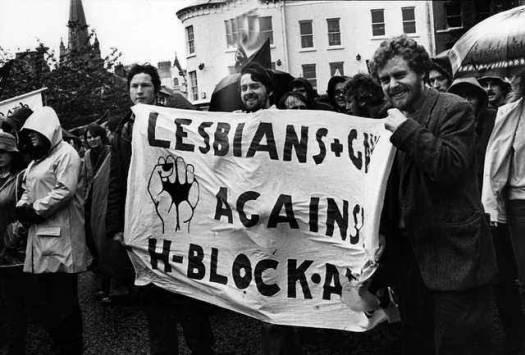

There was an ongoing overlap between Gays Against Imperialism, Lesbians and Gays Against the H-Block, and Sinn Féin with wider gay activism. Cummans themselves brought their banners to these protests in a way that made their support very public.
“This week’s Dublin Pride and indeed the Pride events throughout the country this month are testimony to that strength. And they show that the decriminalisation of sex between men in 1993 here in the 26 Counties did not mean the end of the road for those seeking equality (as some politicians might have liked), but just the beginning. Over a decade ago Sinn Fein became one of the first political parties in Ireland to call for decriminalisation in 26-County law, again because of the efforts of lesbian and gay activists within its ranks. We recognise that we must now meet the challenges of today and confront inequality both within our party and help the struggle to confront it outside our party, throughout society, throughout the country.”
In 2013 Sinn Féin proposed a Gender Recognition Bill to allow transgender people to access documents to legally change gender markers through self-determination. While that version of the bill failed, the party later supported a similar bill introduced by Katherine Zappone and the minister for Social Protection the following year. In 2015 the Gender Recognition Act was passed. Throughout 2014 and 2015 Sinn Féin were vocal supporters of Marriage Equality.
The party had published a policy document on LGBT+ rights in June 2014 for Pride that year, that not only acknowledged that Ireland the last EU country to have gender recognition legislation, but that there was more to do on transgender rights specifically. That document, EQUALITY, DIVERSITY, SOLIDARITY – Fighting with PRIDE for LGBT Rights in Ireland, stated:
“Our transgender citizens also deserve adequate access to appropriate healthcare including specialist treatment and gender reassignment where needed, and for this not to be excluded from coverage as ‘elective’ or as a ‘pre-existing medical condition’. The Equality Authority recommendations in this regard should be implemented in full.”
While this document is still technically available online, it is not visible in the policy document section of the Sinn Féin website and can only be found if you know what key words to enter into a search engine. In fact, there are no policy documents related to LGBT+ issues available in the policy document section of the Sinn Féin website at time of writing.
The party went further in April 2018. Senator Fintan Warfield, who at the time was Spokesperson for LGBTQI+ Rights (a position that no longer exists), published a policy document called ‘On Your Side: a Sinn Féin policy for lesbian, gay, bisexual, transgender, queer, and intersex equality’. This document does not appear to be available from the party, so I provide a link to my own PDF copy from the time. The 30-page document highlighted a number of key issues including mental health, rural isolation, HIV+ treatment and clarity in gender recognition legislation for intersex or non-binary people. It had this to say on trans healthcare:
“We must begin to broaden health services to ensure greater access for the transgender community. Trans people in rural areas are particularly at risk of isolation from services. There is currently one psychiatrist (based at St Patrick’s Hospital, Dublin) qualified to diagnose Gender Identity Disorder available for all transgender people living in Ireland, and one full time public endocrinologist (based in St. Colmcille’s Hospital, Dublin) with expertise in hormone replacement therapy who currently serves the needs of all adult transgender people in this state. As of January 2018, the endocrinology clinic has been reported to have waiting lists of two years. By providing additional training to GPs, and by effectively regionalising services for gender transition, we can move beyond the current Dublin-centric service. In Government, Sinn Féin will work with the HSE to develop strategies to meet the healthcare needs of transgender people. Such strategies will encompass professional training and development, and the provision of accessible information on services, and criteria for accessing such services. We would also seek to include provisions that ensure Dublin-based transgender healthcare services provide regular operation beyond the Dublin region. Furthermore, we would work with the HSE to broaden which medical professionals can monitor and administer HRT.”
It is worth noting that as the party grew following the 2011 general election, it became more difficult for the grassroots cumman structures and democratic processes of the party to grow to scale. This led to some understandable breakdown in communication between leadership and activists. During the COVID period of 2020-2022 that leadership developed a habit of making significant policy decisions without a vote at an Ard Fheis or blatantly contrary to previous Ard Fheis votes. One of the key places this became apparent, though by no means the only one, was LGBT rights.
This was also a period that saw a sharp increase in anti-queer harassment and violence in Ireland. Attacks on libraries over their LGBT material in particular stood out and Sinn Féin was not seen to take any kind of leadership role in opposing this. There were obviously a number of pressing issues at the time, housing, Ukraine, COVID, and the party could have justified not having the resources or media attention to devote to everything. However, attitudes when I spoke to people were not in the tone of “yes, it’s terrible, we’ve just haven’t got to it yet” and more “that’s not really our business”.
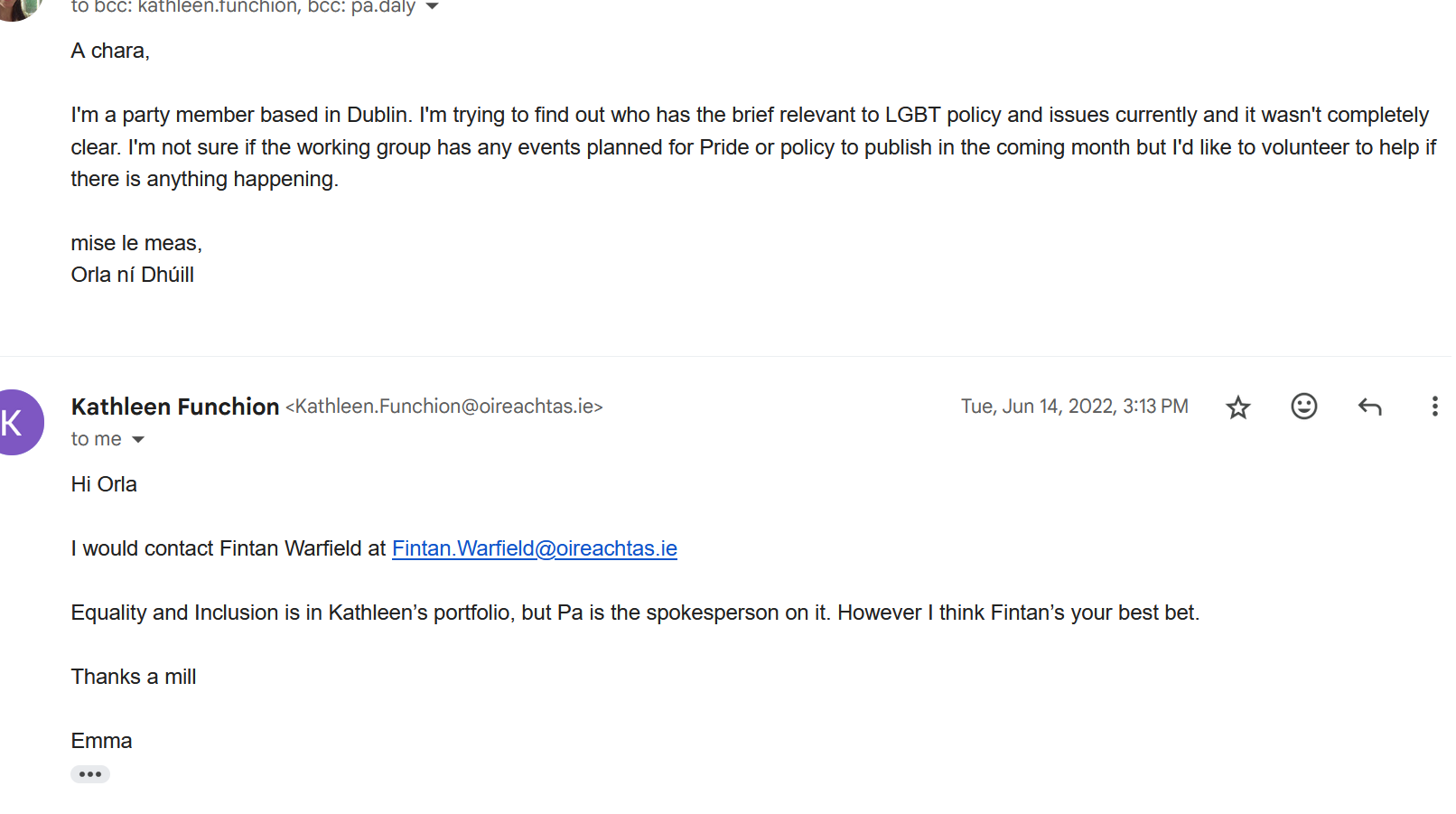
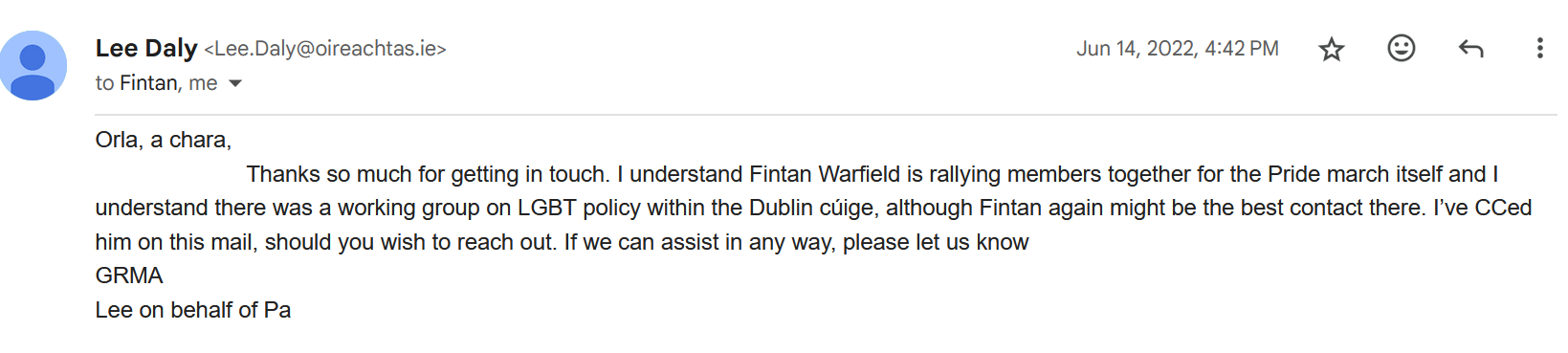
I did reach out to some representatives in that period asking for them to speak more strongly on the attacks, Louise O’Reilly was the only TD that replied to me and, credit where it is due, she gave Dáil speaking time to the attacks. I grew increasingly concerned by attitudes in June 2022 when the party failed to speak on any of the events effecting Irish queer communities in the run up to Pride. I reached out to both relevant spokespeople at the time by email, Kathleen Funchion (then TD now MEP) and Pa Daly TD asking what actions, research or events were happening and volunteering my time as an activist if more hands were needed.
In both cases a member of the spokespersons’ staff directed me away from their offices, who had responsibility for the brief, and towards Fintan Warfield who did not. Fintan just happened to be gay and often organised the banners for the Pride march. In the case of Lee Daly’s response on behalf of Pa Daly, they also directed me towards the former internal working group on LGBT issues which at the time of emailing had not met in two years. Attempts on my part to receive support to have it meet again went nowhere.
In October 2023, I wrote to then Equality Spokesperson John Brady TD to put some of the concerns I had been expression in casual channels into an official complaint so that it would be in writing. I was raising the issue then in response to the alternative budget and ongoing protests at that time outside Loughlinstown Hospital, the National Gender Clinic.
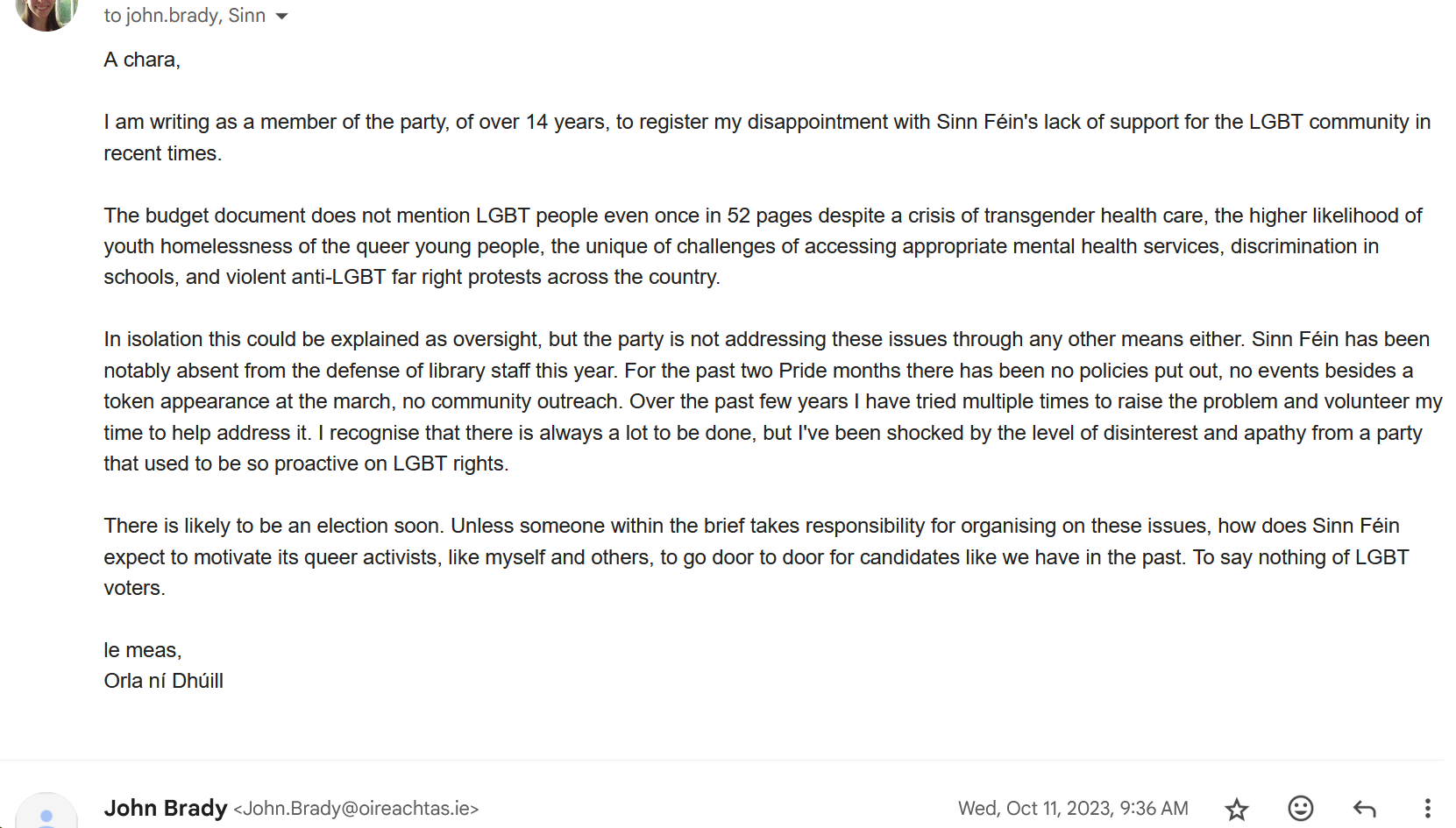

At this point I was obviously frustrated by the lack of acknowledgement that anything was wrong at all. It wasn’t simply that other issues had taken precedent during difficult times; party leadership were simply uninterested in addressing these issues at all.
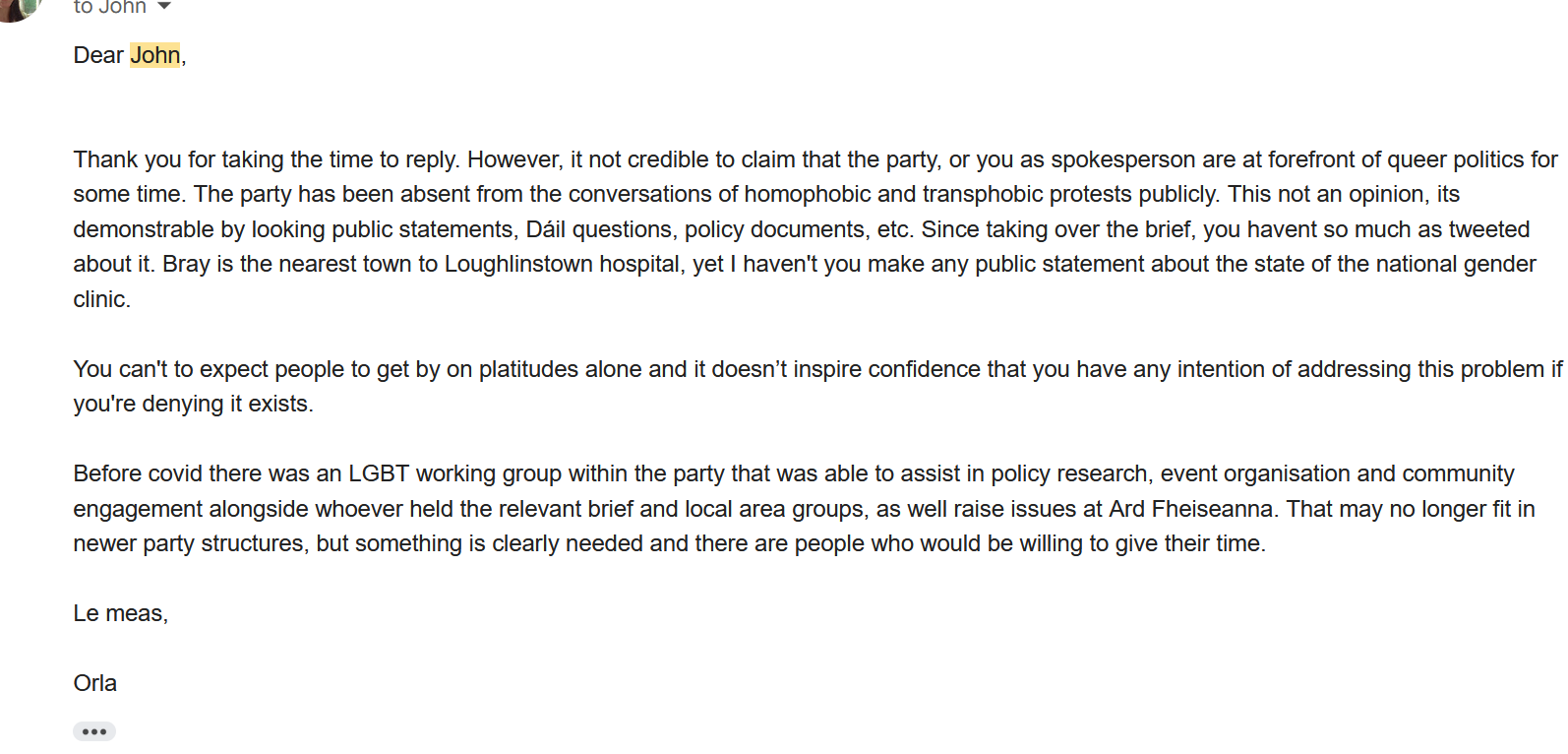
My follow up email and all other attempts to volunteer time and expertise to the matter went unanswered. Shortly after the party reacted to the Dublin riots and years of anti-refugee arson in an unsatisfactory way, so by March 2024 I let my fifteen-year membership of Sinn Féin lapse.
To have in 2024, finally a Sinn Féin First Minister, only to have her stand alongside Emma Little-Pengelly, a DUP leader who was not even elected to Stormont after the party’s long history of homophobia to cheerfully announce a Tory policy was galling, I will admit. Michelle O’Neill said: “clearly we have to have the appropriate support in place for anybody out there who requires gender affirming support” and yet the party raised no objections to the block. Puberty blockers remain available for cisgender children (those who identify with their assigned gender as opposed to transgender), such as those in treatment for early-onset puberty. The medication is therefore clearly considered safe enough for even younger children to use, which fundamentally undermines any medical argument. It is anti-trans sentiment and nothing else.
I can accept being in a party that might not always prioritise what I want, when I want it, but I cannot support a version of the party that has deliberately weakened democratic structures in order to ignore the grassroots who have been on the forefront of queer rights for decades. It simply isn’t a party I recognise.
Sources
Dalton, Eoghan (11 December 2024) ‘Parties in Northern Ireland executive agree to extend Britain’s ban on puberty blockers’ The Journal
Fox, Matt (24 August 2024) ‘Puberty blocker ban extended to Northern Ireland’ BBC
Linehan, Alice (11 December 2024) ‘Northern Ireland permanently bans puberty blockers for under-18s’ GCN
Sinn Féin (September 1996) ‘Moving On – a policy for Lesbian, Gay and Bisexual Equality’ https://www.sinnfein.ie/files/2009/Policies_LGB.pdf
Sinn Féin (June 2014) ‘EQUALITY, DIVERSITY, SOLIDARITY – Fighting with PRIDE for LGBT Rights in Ireland’ https://www.sinnfein.ie/files/2015/LGBT-Doc_June2014.pdf
Sinn Féin (April 2018) ‘On Your Side: a Sinn Féin policy for lesbian, gay, bisexual, transgender, queer, and intersex equality’
 Orla ní Dhúill
Honestly, they are a one issue party and clearly saw SNP implode in Scotland over these wedge issues by right wingers to dismantle left wing (often women led ) nationalism and have walked away from this inane culture war. Reunifying the island is always the main way to ultimately get away from westminister policies. After that if they are still moving away from these issues then the party has no excuse any longer and will be finished as LGBTQ supporters but by that stage SF will have got their main task done and will likely close up shop anyway.
that isn’t really true. for all their faults they are not a one issue party and will definitely not disband after unification. no one thinks that.